
Picture a research team three days out from a major client deliverable. The analyst pulling market data opens her browser, logs into the data platform, and gets a message she hasn’t seen before: subscription inactive. The card on file expired six weeks ago. Nobody got the renewal email because it went to a former employee’s inbox. Now the data she needs is behind a paywall, the finance team is in a different time zone, and the deadline is not moving.
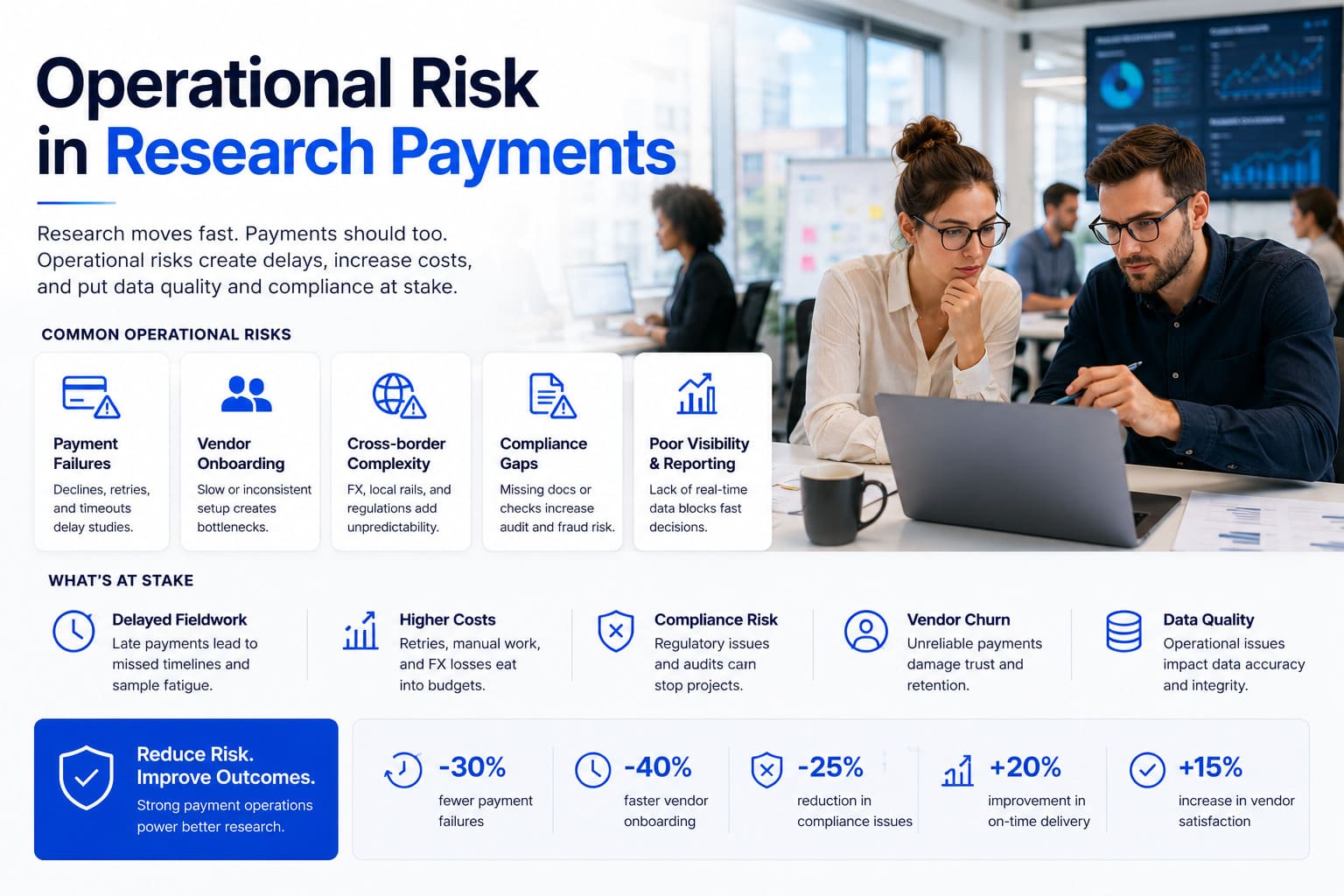
This kind of failure happens more than most research operations managers want to admit. Payments sit at the edge of research workflows — invisible when they work, catastrophic when they don’t. As teams increasingly rely on a web of paid subscriptions, APIs, monitoring tools, and SaaS platforms, payment continuity has quietly become an operational issue, not just a finance one. Some teams have started looking into things like opening a virtual foreign card as one piece of a broader payment resilience strategy, exploring whether purpose-built card controls can protect access to critical vendor services. That instinct is reasonable. The more important question is whether the underlying systems — alerts, ownership, renewal calendars, backup methods — are actually in place.
A card decline looks simple on the surface. But the downstream effects inside a research operation can be messy. A paused API breaks a scheduled data export. A failed survey platform renewal stops a live fieldwork campaign mid-collection. A cloud environment that quietly hits its billing limit suspends a processing job nobody will notice until someone checks the output folder and finds it empty. These are not hypothetical problems. They are the kind of disruptions that research and operations teams encounter regularly, and they rarely get documented or fixed at a systemic level.
This article is a practical look at how payment risk shows up in research workflows — where it comes from, what makes it worse, and what a well-run team can do about it. The goal is not to make payments complicated. It is to make them visible enough that a card decline never becomes a research crisis.
Why Payment Risk Matters
Research teams run on subscriptions. A mid-sized market research operation might carry active billing relationships with a primary data provider, a secondary academic database, one or two survey platforms, an AI-assisted analysis tool, a monitoring or listening service, a cloud environment for processing, and a handful of smaller paid APIs for enrichment or validation. Each of those vendors has its own billing cycle, its own card on file, its own renewal behavior. Some send clear advance notices. Others do not send anything until the payment fails.
The problem is not that any single tool is fragile. The problem is that research workflows connect these tools in sequence. If one link fails, the work downstream from it stops — or produces bad output, which can be worse. A monitoring tool that stops refreshing because of a failed renewal will still show data: it just will not show new data. If nobody checks the timestamp on the last update, the stale information flows straight into a report.
Payments are also invisible in a way that other operational risks are not. A server goes down and an alert fires. A card declines and, in many cases, nothing happens except a quiet failure email to whatever address was on the account at setup — which may belong to someone who left the company two years ago.
Card Declines in Practice
Most card declines are technically mundane. An expired card. A billing address that does not match the issuer’s records. A transaction that triggers a risk check because it came from an unfamiliar merchant or an unusual currency. A corporate card that hit its monthly spending cap. None of these are complicated problems individually. Operationally, though, any of them can interrupt a research workflow at the worst possible moment.
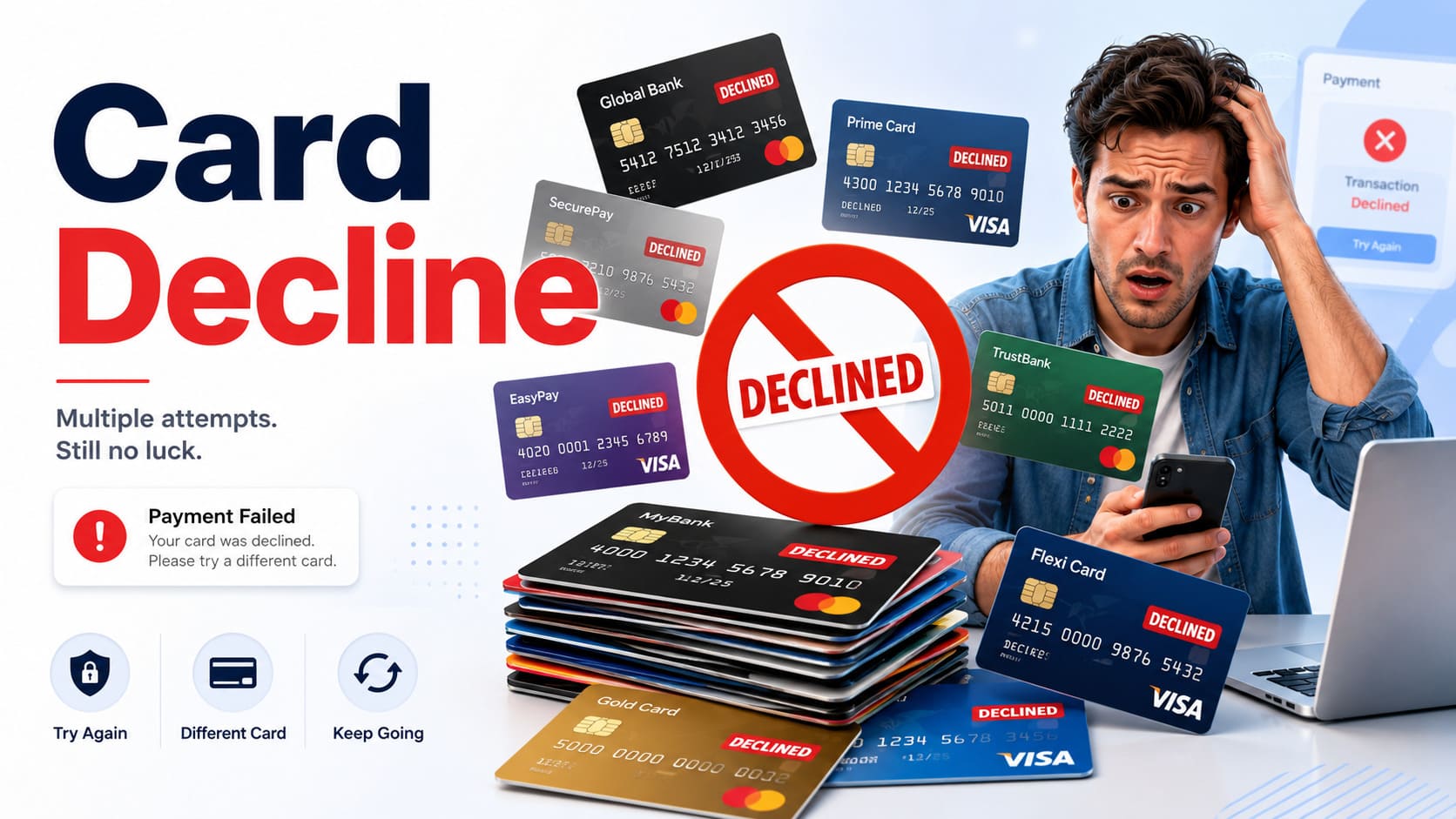
The mismatch between the technical simplicity of a decline and its operational impact is worth sitting with. A billing address entered during an account setup three years ago is not going to update itself when a team moves offices. A card limit set when a research budget was smaller is not going to adjust itself when vendor usage grows. These are small maintenance failures that accumulate quietly until something breaks.
| Decline Reason | What Usually Happens | Workflow Impact | Prevention Habit |
|---|---|---|---|
| Expired card | Renewal silently fails; access paused | Tool goes dark, often unnoticed | Track expiry dates in a shared billing calendar |
| Monthly limit reached | Transaction blocked mid-cycle | API calls fail; exports stop | Set limits above expected usage; review monthly |
| Billing address mismatch | Issuer rejects for AVS failure | Subscription renewal bounces | Audit billing addresses after office moves or rebrands |
| Currency conversion flagged | Issuer blocks foreign merchant charge | International vendor access lost | Use a card with explicit multi-currency support |
| Merchant category block | Corporate policy blocks the MCC | Cannot pay vendor at all | Verify MCC before onboarding new vendors |
| Issuer risk check | Transaction held for manual review | Delayed access; may need re-authorization | Pre-notify issuer for new or large vendor payments |
Merchant Blocks
Merchant blocks are a different category of problem from card declines, and they often get confused. A card decline means the transaction was attempted and rejected. A merchant block means the payment method cannot be used with a particular vendor category at all — the transaction may never get submitted in a meaningful sense. Corporate cards in particular come with merchant category code (MCC) restrictions built in by policy. A card approved for software and SaaS purchases may be blocked at a data brokerage or a survey panel that bills under a different MCC. The vendor is legitimate. The card is active. Nothing is wrong in isolation. They just do not work together.
Processor-side restrictions add another layer. Some vendors operate through payment processors that flag certain business types or geographies for additional review. A research team working with international data vendors may find that their domestic card simply cannot complete a transaction — not because of anything specific to their account, but because the processor or the acquiring bank on the vendor’s side applies rules that the researcher never sees and cannot easily appeal.
Signals that a merchant block — rather than a simple decline — may be the issue:
- The transaction fails immediately with no retry option offered
- The vendor’s payment page does not recognize the card type at all
- The decline message references “card not accepted” rather than a specific rejection reason
- Other card types (e.g., personal cards) succeed where the corporate card fails
- The finance team confirms the card is active and has available credit
- The issue only occurs with one specific vendor, not others on the same card
- The vendor is based in a country or operates in a sector with known processing restrictions
- A previous payment to the same vendor went through on a different card with no issue
- The vendor’s support team confirms they see no payment attempt on their end
Research Tools at Risk
Not every tool fails the same way when a payment lapses. Some platforms are immediate and blunt about it: access is suspended the moment a renewal fails, and a login that worked yesterday produces an error page today. Academic database licenses often work this way. Survey platforms with active fieldwork may pause data collection mid-survey, which can create gaps that invalidate a sample. That is not a recoverable situation if the campaign window has closed.
Other tools degrade quietly. A monitoring or alerts service may keep showing data from its cache while silently failing to pull new information. An AI research assistant might continue to function on its existing usage allowance while queuing up a suspension that fires at the worst moment. Scheduled exports and API calls often fail without surfacing an obvious error — the job runs, returns nothing, and the empty output sits in a folder until someone looks for it.
Cloud environments are particularly risky in this regard. A processing environment that hits a billing threshold may suspend compute resources mid-job, producing corrupted or partial outputs. Recovery can take hours and may require a complete re-run of expensive data processing steps. The practical risk here is not just lost time. It is lost work that appeared to be complete.
Virtual Cards as Controls
Virtual cards have become a genuine operational tool for research and finance teams, not just a security novelty. The core idea is simple: instead of putting one corporate card on fifty different vendor accounts, a team issues a separate virtual card for each vendor — or each project, or each spend category — and manages them individually. A card tied to a single database subscription can be frozen without touching anything else. A card for a one-time data purchase can be set to single-use and then closed automatically.
Most virtual card programs let you set spending caps, restrict the card to a single merchant, set expiry dates, and assign owners. This is not a magic solution — the human process still needs to work. But it creates a much cleaner audit trail and makes it much harder for a single billing failure to cascade across multiple tools.
| Virtual Card Setup | Best Use | Risk Reduced | Human Process Still Needed |
|---|---|---|---|
| Vendor-specific recurring card | Long-running SaaS subscriptions | Limits blast radius of compromise | Monitor renewal dates and limit headroom |
| Single-use card | One-off data purchases, report licenses | Card cannot be reused or stolen | Confirm purchase completion before closing |
| Team-assigned card with cap | Research project spend pools | Prevents overspend; clear ownership | Set cap above realistic need; review monthly |
| Frozen card (dormant vendor) | Vendors not currently active | Prevents unauthorized renewals | Unfreeze deliberately when needed; track status |
Limits and Backup Plans
Spending limits on research cards are usually set once and forgotten. That works fine until a vendor raises its price, a team adds a usage tier, or a project requires heavier API consumption than expected. The card hits its cap, the transaction fails, and — depending on the vendor — the service pauses until someone notices. For tools that bill monthly, that gap can last weeks.
Backup payment methods are underused in research operations. Most teams have one card on file for each vendor and no fallback. A simple improvement is to register a secondary payment method on any vendor whose interruption would be material — a backup card, a bank transfer option, or an invoice arrangement with net-30 terms. This does not need to be complicated. It just needs to exist before the primary method fails.
A billing calendar is the lowest-effort, highest-return continuity tool a research team can build. A shared document — or a set of calendar reminders — that lists every vendor, its renewal date, the card on file, the card’s expiry, and the account owner takes a few hours to create and saves far more than that in incident response. The teams that do this consistently are the ones that catch expiring cards before they become failed renewals.
Compliance and Cross-Border Reality
Research teams increasingly work with vendors in multiple countries — data providers in Europe, survey platforms in the US, AI tools built by companies in Asia. This creates legitimate cross-border payment complexity that is worth understanding, not avoiding.
Currency conversion, foreign transaction fees, and issuer-level restrictions on international merchants are routine issues for any team paying global vendors. The right response is not to look for workarounds — it is to use payment instruments that are designed for international use, to document the business purpose of each vendor relationship clearly, and to ensure that any cross-border payments are compliant with local regulations and the terms of the platforms involved.
One question that surfaces in international payment discussions — particularly for researchers and operations managers dealing with restricted financial access — is how to open a virtual card of a foreign bank from Russia. It is a topic people genuinely research, and it sits at the intersection of sanctions law, local banking regulation, platform terms of service, and KYC/AML compliance. Any approach to cross-border card access needs to start with legal eligibility, proper documentation, bank compliance review, and a clear understanding of what international sanctions frameworks do and do not permit. Legitimate options exist for eligible individuals and businesses through proper channels; the due diligence process for accessing them is not optional.
For research teams working with international vendors more generally, the practical priorities are: confirming that the vendor accepts the card types your organization uses, understanding whether the vendor’s pricing is in a currency your card handles cleanly, and ensuring that any payment arrangement is documented in a way that satisfies your finance and compliance teams.
Ownership and Permissions
The most common single point of failure in research payment operations is not a technology problem. It is an ownership problem. A vendor account was set up by a researcher who has since left the team. The card on file was a personal card that person used because the corporate card had a merchant block. The billing email goes to an alias nobody reads. When the renewal fails, nobody knows who to call or what account credentials to use.
Every vendor relationship needs a designated owner — a named person who is responsible for that account, that card, those credentials, and those alerts. When someone leaves the team, that ownership transfers explicitly. This sounds obvious. It is also one of the most consistently skipped steps in research operations.
Details every research vendor account should have on record:
- Named primary account owner (not a role title — a specific person)
- Named backup owner or successor for continuity
- Card type and last four digits on file
- Card expiry date and next review date
- Billing email address (a shared team inbox, not a personal address)
- Renewal date and billing cycle
- Spending limit on the card and whether it is sufficient for next renewal
- Login credentials stored in a shared password manager with access controls
- Vendor support contact and account number
- Internal cost center or project code for reconciliation
- Date of last successful payment and confirmation record
Fraud and Vendor Risk
Payment fraud in research operations tends to show up in a few specific patterns. Unauthorized renewals — where a vendor charges for a tier or feature the team did not authorize — are common enough to warrant a regular audit. Compromised card details, particularly on cards used across many vendor websites, can result in small test charges that go unnoticed before larger unauthorized transactions follow. Fake invoices that mimic legitimate vendor billing are a real risk in organizations where invoice approval is informal or where billing names are not checked carefully.
Employee turnover introduces another category of risk. A researcher who managed a vendor relationship and then left may still have active credentials — and, in some cases, an active card on their personal device. Offboarding checklists should explicitly include vendor access revocation and card ownership transfer, but in practice this step is skipped more often than it should be.
The PCI Security Standards Council provides a useful baseline for thinking about card data security in organizational contexts — covering how card information should be stored, transmitted, and protected. For research teams that handle card details in any form — even just storing card numbers in a shared spreadsheet — understanding the relevant security standards is worthwhile and not particularly onerous.
Reconciliation
Month-end reconciliation is where payment problems either get caught or get buried. A research team that reconciles vendor charges carefully — matching each line item to a vendor, a project, a card, and an approval — will catch billing anomalies quickly. A team that treats the finance statement as a formality will miss unauthorized charges, duplicate renewals, and price increases until they compound into a budget problem.
The practical challenge is that vendor billing names are often not what you expect. The data platform you know as “ResearchNow” may appear on a statement as a parent company name or a payment processor reference. The AI tool your team uses may bill through a different entity than the product name suggests. Building a reference list of how each vendor appears on billing statements saves significant time during reconciliation.
Monthly payment review checklist for research operations:
- Match every charge to a named vendor and project code
- Confirm the billing name against the expected vendor billing reference list
- Verify that the amount matches the expected subscription tier or usage
- Flag any charge from a vendor not on the approved vendor list
- Check for duplicate charges in the same billing cycle
- Review any failed payment notifications and confirm resolution status
- Confirm that all active cards have sufficient limits for the next month’s renewals
- Check expiry dates on all cards active in the current period
- Verify that billing emails are going to active, monitored addresses
- Confirm that any vendor access changes (additions, removals, tier changes) are reflected in payment records
A Continuity Playbook
The mechanics of a research payment continuity plan are not complicated. The hard part is actually doing them before something breaks. The starting point is a vendor map: a list of every paid tool the research team uses, with renewal dates, billing owners, cards on file, and a rough assessment of how quickly a payment failure would impact active work. Tools in live fieldwork or with daily data dependencies are in a different risk category from annual database licenses used for background research.
From that map, the team can identify which vendors need a backup payment method registered, which card expiry dates are coming up, and which accounts have no clear owner. Those are the three highest-priority fixes. Everything else — alerts, limit reviews, backup access credentials — builds on that foundation.
| Risk Area | Early Warning | Owner | Backup Action |
|---|---|---|---|
| Card expiry | Billing calendar alert 60 days out | Account owner | Update card or issue new virtual card before expiry |
| Renewal failure | Vendor billing email to shared inbox | Finance ops | Backup payment method registered on vendor account |
| Spending limit hit | Card issuer alert at 80% usage | Account owner | Pre-approved limit increase process with finance |
| Merchant block | Failed transaction on new vendor setup | Finance ops | Alternative card type or invoice arrangement |
| Owner departure | HR offboarding trigger | Team lead | Ownership transfer checklist; shared credentials in password manager |
Common Mistakes
Most research payment failures trace back to a small set of recurring mistakes. They are predictable, preventable, and almost always caught in retrospect — which is the wrong time to catch them.
- One shared card for every research vendor, with no isolation between critical and non-critical tools
- No renewal calendar — renewals are discovered when they fail, not before
- Vendor accounts owned by individuals, not teams — when the person leaves, the access and billing context go with them
- Decline alerts ignored or going to unmonitered email addresses
- Billing names not mapped — teams cannot identify charges on their own statement
- No backup payment method on any vendor account
- Card limits set at initial onboarding and never reviewed as vendor usage grows
- Billing emails tied to personal addresses rather than shared team inboxes
- No offboarding process for vendor access when researchers leave the team
Conclusion
Card declines and merchant blocks tend to get treated as minor finance annoyances — someone calls the bank, updates a card number, and the problem is resolved. But inside a research operation, the gap between a payment failure and resolution can span days, and those days may contain a live survey, a client deadline, or a data pipeline that has quietly stopped producing output. The technical fix is usually simple. The operational damage is not always reversible.
The best protection is not a clever workaround or an elaborate technology stack. It is clear ownership of every vendor relationship, compliant payment instruments that are sized and configured for actual usage, alerts that go to people who will act on them, and documentation that survives employee turnover. None of that is complicated. All of it requires discipline to actually do before the next renewal fails.
The research teams that handle payment risk well are the ones that treat billing as part of the work, not an afterthought to it.